













Carbon capture and storage (CCS) has moved beyond theoretical climate modelling into the realm of infrastructure planning, capital allocation, and regulatory design…
Carbon capture and storage (CCS) has moved beyond theoretical climate modelling into the realm of infrastructure planning, capital allocation, and regulatory design. DNV’s latest Energy Transition Outlook for CCS characterizes 2025 as a critical year, highlighting that global capture and storage capacity has reached a turning point, driven by near-term expansion in North America and Europe.
 Jamie Burrows, Global Segment Lead, CCUS at DNV © DNV
Yet the same outlook makes clear that, even with this acceleration, CCS remains far below the level required to deliver net zero by mid-century.
For Jamie Burrows, Global Segment Lead, Carbon Capture, Utilization, and Storage (CCUS) at DNV and one of the report’s authors, the central issue is no longer whether CCS has a role in the energy transition - it is whether the industry can deploy it at sufficient speed, in the right sectors, under the right policy frameworks.
A Necessary Technology in a Hydrocarbon-Heavy System
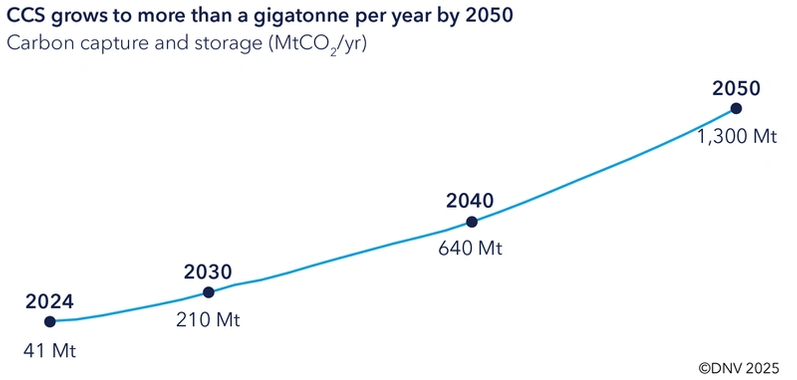 DNV CCS forecast to 2050 CCS grows to more than a gigatonne per year by 2050 © DNV
Burrows places CCS within the structural realities of the global energy mix.
“If you look at credible forecasts of how the world's energy
Content Original Link:
" target="_blank">


